-
Adapting Research Through Cross-Campus Collaboration - No Need to Reinvent the (Cheese) Wheel
Emily Roberts, Lori Townsend, and Alyssa Russo
This lightning talk centers on cross-campus partnerships as a catalyst for research translation and innovation. A health sciences librarian collaborated with members of a general academic library research team at the University of New Mexico to adapt an existing qualitative study on students’ online information evaluation for a nursing context. Rather than starting from scratch, the new team intentionally translated methods, instruments, and approaches to fit a new population and disciplinary setting. This session highlights the collaborative process itself: how partners negotiated context-specific changes, documented adaptation decisions, and preserved methodological rigor while meeting new needs. Although the study’s findings are still in progress, the focus here is on lessons learned from translating research across campuses and specialties. Attendees will gain practical insights into building productive research partnerships, reusing and adapting existing studies, and expanding health sciences research by drawing on the broader academic library community.
Objectives
Building on a qualitative study of undergraduate students’ perceptions of online information at a “main campus” library, a health sciences librarian is collaborating with members of the original team to adapt it for nursing students.This adapted study aims to understand how these students decide what online information to trust and how they evaluate online information sources, particularly when it comes to health topics. Through adapting the methodology to suit a new student population and context, we aim to develop a framework for translating research from the broader body of general academic library research to the health sciences.
Methods
This qualitative study will use semi-structured interviews with nursing students. Interviews include a think-aloud web and AI evaluation activity, brief evaluations of selected health websites, and a demographic survey. Interview transcripts are analyzed using coding and thematic analysis to identify patterns, and data collection continues until thematic saturation is reached. The recruitment, interview, and analysis protocol is collaboratively adapted from the general academic library study. The adaptation process is intentionally considered and documented to identify effective strategies for cross-campus librarian collaboration and study translation.
Results
Research is currently in progress; results are not yet available.
Conclusions
This study will contribute insight into graduate nursing students’ online information evaluation practices and inform health sciences information literacy instruction. This work offers guidance on successful cross-specialty collaboration and demonstrates how health sciences librarians can advance their research by drawing inspiration from the broader community of academic librarians.By highlighting the process of adapting research across settings, it encourages librarians to pursue cross-campus partnerships as a way to innovate and expand their research.
-

A Scoping Review of Empirical Research on Post-Retraction Citation
Will White, Caitlin Bakker, Susmita Das, Yuanxi Fu, Esther Hsiao, Jess Rogovin, and Jodi Schneider
This scoping review examines post-retraction citations as a proxy for epistemic risk (i.e., the likelihood that one holds a false or inaccurate belief). It aims to describe the current landscape of empirical research on post-retraction citation, with the specific aim of determining the extent of epistemic risk and describing how that risk may manifest and result in epistemic harm.
-
Cultivating Open Data Repository Discoverability Through Cultured Collaboration: A Lightning Talk
Robyn Gleasner, Leah A. Everitt, Danielle E. Maurici-Pollock, and Laura J. Hall
Background:
Open data repositories are essential for promoting research transparency, reproducibility, and collaboration. However, many researchers struggle to locate relevant repositories due to fragmented information and lack of centralized guidance. This lightning talk will describe how librarians addressed this challenge through teamwork and collaboration by curating a list of open data repositories to assist in providing a pathway for discovery.
This project aims to enhance the discoverability of open data repositories to support instruction, research, clinical practice, and interdisciplinary collaboration as well as promote open science within the university health sciences center community.
Description:
General selection criteria were developed based on an academic health sciences library’s collection development manual to ensure quality and relevance in scope to subject areas the library serves. Library faculty input was solicited to recommend open data repositories. A rubric was then developed to assist the evaluation team in further determining the scope, quality, and trustworthiness of the data repository including download options, user support, creator information, and available metadata.
Ninety-four repositories were recommended by faculty and the evaluation team to be evaluated. Fifty-six of these met the criteria and were selected to be made more discoverable. The team chose to create the Open Data Repositories LibGuide to share the curated list of repositories grouped by topic. ChatGPT was used to categorize the repositories by topic and then results were manually checked by the evaluation team to ensure accuracy. ChatGPT was also used to suggest short descriptions of the repositories to assist researchers in finding matches for their open data needs.
The LibGuide will be promoted at student and faculty orientations, via data-related LibGuides, and via the library blog. Usage statistics will be evaluated every 6 months as well as assets listed on the page.
Conclusion: The Open Data Repositories LibGuide was published in July 2025 and serves as a centralized, user-friendly resource that enhances the visibility and accessibility of open data repositories. Initial engagement, metrics, and user feedback suggest improved navigation and increased awareness among faculty and students. Future plans include connecting topics for more relevant discovery and collaborating with users to add more open data repositories.
-
Designing and Evaluating a PubMed Metadata Text Mining Software Program
Leah A. Everitt
Presentation at the 2026 Medical Library Association Annual Meeting
Abstract
Objectives – Author keywords are an underutilized metadata field, but represent important specialized natural language that concisely describes research. Now that Medline Indexing is largely done by automated indexing there are fewer people suggesting new MeSH terms, which limits its usefulness and relevance. Highly used author keywords could be a new source of MeSH terms, therefore a text mining python software program that analyzes and suggests new Medical Subject Heading (MeSH) terms based on PubMed search result author keywords was designed and evaluated. This python program is of interest to health science librarians engaged in maintaining MeSH and those who frequently use MeSH. 101/100
Hypothesis - A text mining python software program can identify author keywords that are not yet MeSH terms.
Methods – Visual code studio, Microsoft Copilot, and Jupyter Python Notebooks were used to create a text mining python software program. The program was then evaluated by testing the software using a use case. A PubMed search was conducted, osteosarcoma AND dog, then a PubMed metadata file of all results was saved. This file was then loaded into the program. The program then finds all of the Author Keywords and creates a ranked list of how many times the Author Keyword appeared in the search results. Any existing MeSH terms and MeSH entry terms are deleted from this list. Any Author Keywords that are also MeSH Supplemental Records are put into their own ranked list. Then the program deletes MeSH Supplemental Records to create a ranked list without MeSH Supplemental Records. The program returns all these ranked lists to the user and creates a txt file. It was confirmed that found Author Keywords were not MeSH terms, entry terms, MeSH Supplemental Records nor Supplemental Records entry terms using the MeSH database.
Results – The program was able to take a PubMed metadata results file and provide ranked lists of the most used Author Keywords, Author Keywords that are not MeSH terms, Author Keywords that are not MeSH entry terms, and Author Keywords that are not MeSH Supplemental Records. For the PubMed Search osteosarcoma AND dog the most common Author Keyword was osteosarcoma. After removing MeSH terms the most common Author Keyword was canine. After removing both the MeSH terms and MeSH entry terms the most common Author Keyword was also canine. Canine remained the most common after removing MeSH Supplemental Records and Supplemental record entry terms.
Conclusions – The program could identify Author Keywords that were not MeSH terms nor MeSH entry terms. These terms represent potential new MeSH terms. Unexpectedly, the term canine which is commonly used both by researchers and lay-people was neither a MeSH term or entry term. There are two MeSH terms Canidae and Dogs which also represent the concept of canine but canine is not an entry term for either of these concepts. Not only can this program identify potential new MeSH terms it can also suggest terms that can be added as MeSH entry terms. The next step of this project is to create a user-friendly web-interface for the program so it can be used by interested health science librarians and researchers.
-
Health Sciences Library Service Request Web Submission Form Re-Design
Leah A. Everitt, Robyn Gleasner, Kristin Proctor, Amy Weig-Pickering, and Moses Moya
Abstract
Background
At an Academic Health Sciences Library, library workers were experiencing issues with user-submitted information from their reference service request form. The information was often incomplete making it difficult to triage and complete requests. Additionally, two different forms were being used to request reference services. Finally, there was not a centralized place for users to request other library consultation services such as Research Data Management and Special Collections service requests. The aim of this project was to create a new form that centralizes service requests and consolidates the two forms already in use.
Description
A draft form was created by librarians involved in service request triage and the reference service. Feedback was requested from all Health Science Library Departments involved in providing library services during their department meetings. These three departments handle library questions, reference, and consultation requests through the LibAnswers ticket system. Feedback on the draft was requested via email using a shared draft document and then in-person at department meetings. Following each department meeting the draft form was improved.
Next the shared document draft form was drafted as a LibAnswers Widget Form. It was found that not all of the planned form functions could be implemented. It was hoped that the new form would be able to route service requests to the correct department directly. However, this type of logic was not able to be implemented using the LibAnswers Widget due to form logic and queue limitations. Additionally, after discussion with relevant departments, it was determined this type of routing by end-users could be problematic due to inaccurate information.
Finally, all departments were asked for feedback on the draft Widget Form via email, at two weekly all-hands meetings, and anecdotally. Improvements to the form were implemented after this feedback.
Conclusions
The new form was implemented on the Health Sciences Library's website. One feedback email was received which discussed how automated routing of requests to specific departments could be implemented. This feedback was not implemented due to concerns from the team that users often mis-categorize their requests and this could result in a confusion about which department should handle requests and that requests would be lost. No feedback was received at the all-hands meetings. Anecdotal feedback from the relevant departments has been positive, noting that user-submitted information is more comprehensive and easier to use. In the future the direct routing of service requests to individual departments may be re-visited.
-
MeSH Recommender Demonstration
Leah A. Everitt
HSLIC is pleased to announce the launch of a new PubMed metadata analysis tool MeSH Recommender. MeSH Recommender takes PubMed metadata extracts Author Keywords, compares these to Medical Subject Headings (MeSH) and Supplementary Headings to create a list of Author Keywords that doesn't include MeSH. This tool may be of interest if you are conducting an evidence synthesis project or you're interested in suggesting a new MeSH term to the National Library of Medicine. This short session will:
- Provide use cases for the site
- Demonstrate how to use the tool
- Ask attendees if they would be interested in providing anonymous feedback on the site
Explore the site: https://meshrecommender.org/
Leah Everitt, MSLS and Assistant Professor is the creator of MeSH Recommender, contact them at [email protected] with any questions.
-
Powering Up Clinical Scholarship in Urology
Evelyn Wang
This presentation introduces core concepts of clinical scholarship for urology residents and faculty, with a focus on turning clinical questions into structured literature searches and using HSLIC resources to support small-scale scholarly projects. Key topics include framing answerable clinical questions (e.g., PICOT), navigating core clinical information tools (PubMed, EMBASE, CINAHL, ClinicalKey, UpToDate, HSLIC LibGuides), applying practical literature search techniques (Boolean operators, truncation, wildcards, proximity operators, subject headings), documenting basic search strategies, accessing full text (LibKey Nomad, proxy authentication, interlibrary loan and document delivery), and an introductory overview of critical appraisal tools and publishing supports available through HSLIC.
-
Promoting a Culture of Research through Programming: Library Research Works in Progress
Leah A. Everitt, Deirdre Caparoso, Danielle Maurici-Pollock, Emily Roberts, Jon Elderdge, and Melissa Rethlefsen
Our health sciences library recently made it a strategic goal to advance our research impact which was instigated as our library faculty recently were given the option to be tenure-track faculty. To support this goal, we created a program aimed at promoting good research practices and a culture of research collaboration where library team members present their in-progress research projects to garner feedback from colleagues or library research articles to enhance our ability to critically appraise published research. Come to this presentation to learn about our program Research Works in Progress.
Abstract
Background:
In November 2020, a tenure-track option was added as an academic health sciences library faculty’s career advancement path. In all tracks, librarians are evaluated for Education/Librarianship, Research/Scholarship, and Service/Administration. One criterion for promotion and tenure in the tenure track is a requirement to achieve excellence in Research/Scholarship. Additionally, the library’s strategic plan includes a goal to advance research impact, in part by offering library personnel mentorship, providing opportunities to collaborate with peers, and reestablishing a journal club. One step in this strategy to advance research impact and support new tenure track faculty was starting a regular seminar series to discuss librarians’ current and planned research to promote collaboration and a culture of research.
Description:
To establish Research Works in Progress (RWIP) as a regular event, the library’s two tenured faculty invited all tenure track faculty to a weekly seminar. To begin, topics were chosen by tenured faculty and focused on getting started in research, including “how to” discussions on research methods and data management. Faculty also presented their own current research, whether in the ideation stage or completed. This enabled faculty newer to research to get ideas and feedback from peers, and to see what completed health sciences librarian research looked like. After completion of a new conference room that allowed more participants, RWIP was opened to the entire library faculty and staff. Any library team member can sign up for a spot on a shared Excel document to share their latest in-progress research project. Team members decide which research projects would be best to discuss, under guidance from tenured faculty, although the focus is on getting feedback from colleagues in early project stages. After a regular rhythm of meetings was established, monthly journal club sessions were added to build additional skills in reading, critiquing, and using literature. The program has been evaluated through faculty feedback, tenure advancements, and increased research collaborations and awards.
Program Conclusion:
Since RWIP was established, there has been an increase in faculty research projects. Requirements to draft abstracts for conferences, and to share those with colleagues at RWIP prior to submission, have led to increased submissions and collaborations. Faculty feedback has established that RWIP has provided motivation to work on their research projects more and to make more consistent progress. Regional research awards for faculty showcase progress towards advancing the library’s research impact. Finally, one faculty member has successfully undergone mid-probationary review, and one other is in the process. Health sciences libraries that want to promote library research may wish to establish similar programs, especially where a culture of research does not already exist.
-
Providing Reference Services on Complimentary, Alternative and Traditional Medicine
Emily Roberts and Leah Everitt
With increasing public debate on complimentary and alternative medicines (CAM) library workers of all stripes need to be empowered to provide reference services on these topics.
Participants will leave this session with knowledge of relevant consumer health tools and resources on CAM. Open access resources will be emphasized. They will be able to offer patrons instruction on evaluating the relevance, accuracy and usefulness of information on these topics.
Presenters come from The University of New Mexico’s Health Sciences Library & Informatics Center where they provide instruction on these topics to health sciences students in pharmacy, nursing, and allied health programs.
-
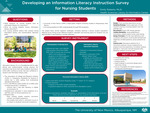
Developing an Information Literacy Instruction Survey for Nursing Students
Emily Roberts
Objective:
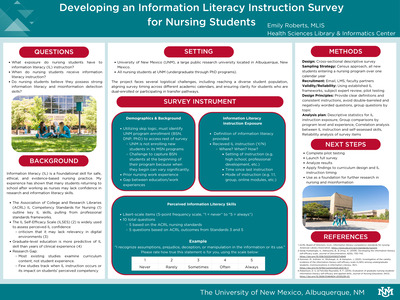
This project aims to develop a survey to assess the experience of nursing students across various programs with information literacy (IL) instruction. In addition to collecting data on instructional exposure, the survey will gather students' self-assessed proficiency in core IL skills, with particular attention to identifying misinformation and recognizing personal bias. A key objective is to explore what relationships may exist between self-perceived IL competency and factors such as previous IL instruction, educational background, work experience, and the recency of instruction. The poster will outline the planning and development process involved in creating and piloting the survey.
Methods:
The research draws on a review of existing literature on IL instruction and competency surveys in nursing and other health sciences education. Best practices in survey design—question formulation, validation, pilot testing, and distribution strategies—are used to guide instrument development. Feedback from nursing faculty and librarians informs revisions.
Results:
As research is ongoing, survey results are not yet available. Early insights from the design and planning phase will be shared.
Conclusions:
This work will contribute to a deeper understanding of nursing students’ IL development and supports creating more targeted instruction. It also lays the groundwork for future research exploring nursing students’ relationship to health misinformation.
-
Enhancing Evidence-Based Practice in Publishing Stage (December 1, 2025)
Evelyn Wang
This presentation, delivered at the Evidence-Based Practice Council Monthly Meeting, guides participants through best practices in selecting target journals, evaluating journal quality, reviewing submission guidelines, and understanding open access publishing options. It introduces the JANE tool for journal recommendations, resources for evaluating journal credibility (Think. Check. Submit., DOAJ, Journal Citation Reports), and institutional open access agreements. Consultation and support services provided by HSLIC librarians are highlighted.
-
Enhancing Evidence-Based Practice: PICOT Search in CINAHL Database – Evidence-Based Practice Council Monthly Meeting
Evelyn Wang
This presentation introduces the PICOT Search feature in the CINAHL Database, demonstrating steps to activate PICOT on EBSCOhost and its application for precise clinical literature searches. The session provides practical guidance for clinicians and researchers to utilize evidence-based resources efficiently.
-

Exploring Generative AI in Health Sciences: A Qualitative Snapshot from a Multisite Study
Laura J. Hall and Robyn Gleasner
Background: This study is part of a two-year, multi-institutional initiative led by Ithaka S+R examining how generative AI (GAI) is shaping higher education. 19 North American institutions, including the University of New Mexico (UNM), conducted 15–20 semi-structured faculty interviews exploring the impact of GAI on teaching, research, and academic practice. 246 interviews were completed nationally.
Objective: Explore faculty perceptions, uses, and concerns related to GAI in teaching and research to identify support needs.
Participants: 20 faculty across various disciplines at UNM were interviewed. This poster highlights interviews with 7 health sciences from internal medicine, pathology, psychiatry, nursing, radiology, and population health. Research interests among participants included health equity, substance use disorders, diagnostic tools, and machine learning.
Methods: Semi-structured interviews were conducted via Zoom in Spring 2024. Transcripts were analyzed using an emergent, in-vivo coding process to identify themes related to GAI familiarity, use, and needs.
-
How to Dump Dewey: Developing Your Own Classification Scheme
Emily Roberts
As librarians, we frequently encounter challenges with classification systems such as Dewey Decimal because they do not always meet the specific needs of our collections, spaces, and patrons. This presentation will delve into creating customized classification schemes for public, school, and special libraries to organize materials better and streamline staff and patron use. I will provide examples of various tools, strategies, and methods for altering or replacing traditional classification systems. Additionally, rationales for creating your own classification scheme and the pros and cons of doing so will be explored. UNM’s Center for Development and Disability special library will be used as a case study.
-

Integrating Zotero with Your Writing: From Research to Publication
Evelyn Wang
This workshop presentation provides a comprehensive hands-on guide to using Zotero for research and writing. It covers installation, browser connector setup, reference collection from databases and websites, organization through collections and tags, citation insertion in Word and Google Docs, bibliography generation, PDF management with annotation and search, and advanced features such as synchronization, collaboration, ZoteroBib, and custom citation styles. The presentation’s goal is to support researchers, students, and clinicians in efficiently managing citations and references from literature review to publication.
-
Integrating Zotero with Your Writing: From Research to Publication
Evelyn Wang
This workshop presentation provides a detailed guide on using Zotero for research and academic writing. It includes instructions on installation, reference collection, organization, citation insertion, bibliography generation, PDF management, and advanced features such as collaboration tools and custom citation styles. The presentation is designed to improve researchers' and writers' efficiency in managing references throughout the research and publication process.
-
Libraries Are For Every Body: Serving Library Patrons with Disabilities
Emily Roberts
This poster presents a special library's unique collections, programs, and services. It is one of only a handful of libraries in the country specifically designed to cater to adults and children with disabilities, their families, caregivers, and professionals who work with them. The poster aims to offer ideas and strategies for creating more welcoming and inclusive libraries for people with disabilities. It will showcase a variety of strategies used to develop inclusive collections, accessible services, and engaging programs designed to address the diverse needs of these patrons. Additionally, it will present success stories and potential pitfalls, offering insights into community building and evaluation. Attendees will learn practical approaches they can apply in their libraries. The poster will feature visual elements such as usage charts, photographs of library activities and collections, and patron testimonials. Viewers can assess the poster's impact by scanning a QR code to take a survey.
-

Libraries Supporting Open Access: An Environmental Scan
Robyn Gleasner, Laura J. Hall, and Danielle E. Maurici-Pollock
-
Navigating Solo Librarianship in a Health Sciences Setting
Emily Roberts
Solo librarianship can be both rewarding and isolating, especially in a specialized health sciences environment where the librarian is responsible for a full spectrum of services. I will discuss my experiences of solo librarianship at one of only a handful of special libraries dedicated to developmental disabilities in the United States. This unique setting required balancing niche subject expertise, information literacy instruction, and user advocacy, all while navigating limited resources and institutional visibility.
I will discuss the importance of leveraging cross-departmental relationships, partnering with broader library networks, and explore how to advocate for library services in a clinical and research-focused environment. I will also address challenges like professional isolation, workload, and keeping pace with trends in medical librarianship without a team.
This talk will interest attendees who are solo librarians or who work with them in academic, hospital, or research settings. Attendees will gain practical strategies for managing competing demands, raising the library’s profile, and maintaining professional growth in independent roles.
-

Powering Up Clinical Practice: Mastering Clinical Literature Search Techniques in EMBASE
Evelyn Wang
This workshop guides clinical faculty and researchers through advanced literature search skills using EMBASE. Covers navigation, clinical question translation, keywords, Emtree terms, proximity/Boolean operators, pilot searches, result evaluation/organization, and pathway integration. Practical demonstrations and search tips included.
-
Powering Up Clinical Practice: Mastering Clinical Literature Search Techniques in EMBASE
Evelyn Wang
This workshop presentation, "Powering Up Clinical Practice: Mastering Clinical Literature Search Techniques in EMBASE," is designed to enhance healthcare professionals’ skills in conducting effective clinical literature searches using EMBASE. The session covers efficient navigation of EMBASE, transforming clinical questions into search concepts, developing advanced search strategies with keywords and Emtree terms, applying search tips (Boolean logic, truncation, wildcards), conducting pilot searches, refining search strategies, and managing results for clinical decision-making. Additional resources and HSLIC services are introduced to support literature review and research workflows.
-

Powering Up Clinical Scholarship in Dental Journal Club: Article Review Session 1
Evelyn Wang
This presentation is designed for Dental Services Journal Club attendees as Session 1 of an article‑based workshop series on clinical scholarship, using three exemplar papers on drug‑induced gingival overgrowth (Mavrogiannis 2006, Fardal 2015, Mawardi 2021) to illustrate how to read, interpret, and critically appraise different study designs (narrative review, retrospective cohort, systematic review). The session emphasizes understanding methods and limitations (e.g., non‑systematic literature searching, confounding and missing data, lack of baseline matching, single‑center bias, heterogeneous treatments), interpreting risk of bias and evidence levels, and applying structured critical appraisal language so that dental clinicians can more confidently evaluate periodontal and pharmacologic evidence in real‑world cases.
-
All of Us: Using Big Data to Study Factors Affecting Health and Health Impacts
Deborah Rhue, Todd Quinn, Lori D. Sloane, and Karl Benedict
The NIH All of Us Research Program brings together health and associated survey data on over 750,000 diverse Americans. UNM and UNM HSC researchers and students can use the All of Us data and analysis platform to address public health and biomedical research questions. Learn more about the All of Us Research Program. We will provide information about the different data sets and tiers of access available, the onboarding required, and available training options.
Printing is not supported at the primary Gallery Thumbnail page. Please first navigate to a specific Image before printing.