


Presentation Date
5-22-2026
Files
Download Full Text (651 KB)
Description
Background:
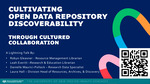
Open data repositories are essential for promoting research transparency, reproducibility, and collaboration. However, many researchers struggle to locate relevant repositories due to fragmented information and lack of centralized guidance. This lightning talk will describe how librarians addressed this challenge through teamwork and collaboration by curating a list of open data repositories to assist in providing a pathway for discovery.
This project aims to enhance the discoverability of open data repositories to support instruction, research, clinical practice, and interdisciplinary collaboration as well as promote open science within the university health sciences center community.
Description:
General selection criteria were developed based on an academic health sciences library’s collection development manual to ensure quality and relevance in scope to subject areas the library serves. Library faculty input was solicited to recommend open data repositories. A rubric was then developed to assist the evaluation team in further determining the scope, quality, and trustworthiness of the data repository including download options, user support, creator information, and available metadata.
Ninety-four repositories were recommended by faculty and the evaluation team to be evaluated. Fifty-six of these met the criteria and were selected to be made more discoverable. The team chose to create the Open Data Repositories LibGuide to share the curated list of repositories grouped by topic. ChatGPT was used to categorize the repositories by topic and then results were manually checked by the evaluation team to ensure accuracy. ChatGPT was also used to suggest short descriptions of the repositories to assist researchers in finding matches for their open data needs.
The LibGuide will be promoted at student and faculty orientations, via data-related LibGuides, and via the library blog. Usage statistics will be evaluated every 6 months as well as assets listed on the page.
Conclusion: The Open Data Repositories LibGuide was published in July 2025 and serves as a centralized, user-friendly resource that enhances the visibility and accessibility of open data repositories. Initial engagement, metrics, and user feedback suggest improved navigation and increased awareness among faculty and students. Future plans include connecting topics for more relevant discovery and collaborating with users to add more open data repositories.
Document Type
Presentation
Conference/Presentation Location
MLA 2026
Keywords
open data repositories, data discovery
Recommended Citation
Gleasner, Robyn; Leah A. Everitt; Danielle E. Maurici-Pollock; and Laura J. Hall. "Cultivating Open Data Repository Discoverability Through Cultured Collaboration: A Lightning Talk." (2026). https://digitalrepository.unm.edu/hslic-posters-presentations/229